

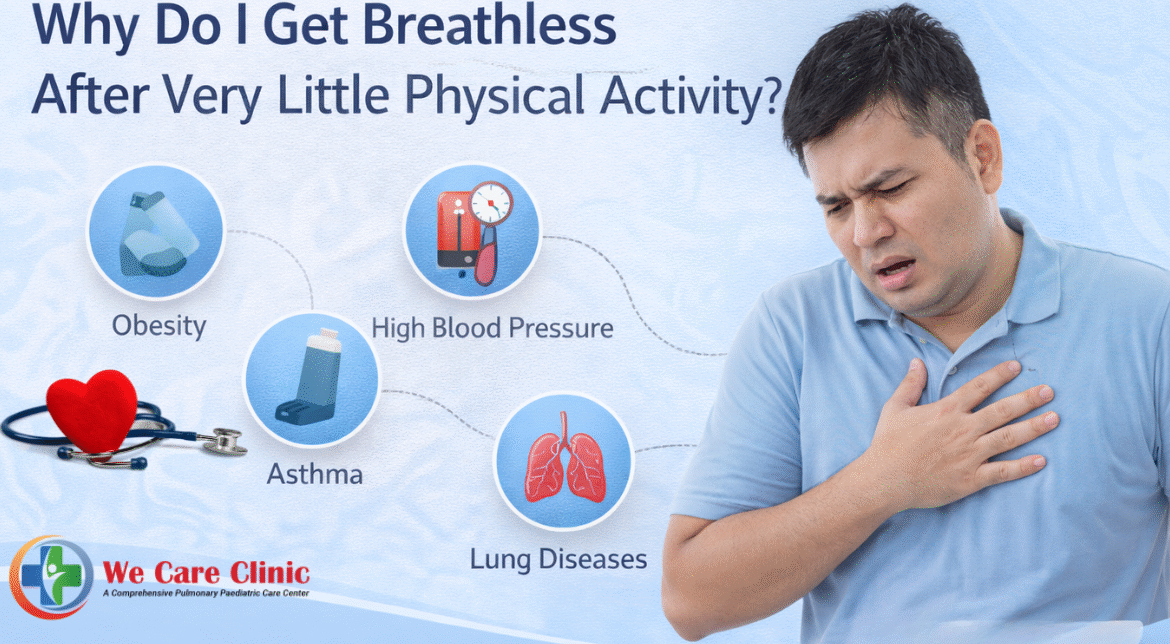
Why Do I Get Breathless After Very Little Physical Activity?
Feeling breathless after climbing a few stairs, walking a short distance, or doing light household work can be confusing and worrying. Many people brush it off as tiredness, lack of fitness, or age. But when breathlessness starts happening with very little physical activity, it is often a signal that your body needs attention.
Understanding why this happens is the first step toward protecting your lung and overall health.
Is Breathlessness After Mild Activity Normal?
Occasional breathlessness after intense exercise can be normal.
But getting breathless during simple daily activities such as walking, bending, or light exertion is not normal, especially if it:
- Happens repeatedly
- Is getting worse over time
- Comes with chest tightness, cough, or fatigue
- Was not present earlier in your life
Your body uses breathing as an early warning system. When oxygen demand is not being met properly, breathlessness appears.
Common Reasons You May Feel Breathless Easily
1. Reduced Lung Capacity
Lungs may not be able to expand or exchange oxygen efficiently due to:
- Past infections
- Long-term pollution exposure
- Early lung disease
This causes even small physical effort to feel exhausting.
2. Poor Physical Conditioning
If you have been inactive for a long time, your body may struggle initially.
However, conditioning-related breathlessness improves with time.
⚠️ If it does not improve or keeps worsening, fitness is likely not the real issue.
3. Asthma or Airway Sensitivity
Some people have mild or undiagnosed asthma.
This can cause:
- Breathlessness during walking or climbing
- Tight feeling in the chest
- Wheezing or cough, sometimes without sound
Asthma does not always start in childhood it can appear in adults too.
4. Anemia (Low Hemoglobin)
When your blood cannot carry enough oxygen, the heart and lungs work harder.
Symptoms include:
- Breathlessness with mild activity
- Fatigue
- Dizziness
Anemia is common and often overlooked.
5. Heart-Related Issues
The heart and lungs work together.
If the heart is not pumping efficiently, oxygen delivery reduces, leading to early breathlessness.
This is more common if you have:
- High blood pressure
- Diabetes
- A family history of heart disease
6. Lung Conditions That Start Silently
Some lung conditions do not start with cough or pain.
Instead, the first sign is:
This includes conditions like:
- Early interstitial lung disease (ILD)
- Chronic lung inflammation
- Post-infection lung changes
7. Anxiety or Stress (But Not Always the Cause)
Anxiety can cause shortness of breath, but it should be a diagnosis of exclusion.
Many patients are told “it’s just anxiety” when an underlying lung issue actually exists.
Breathlessness should never be ignored without proper evaluation.
When Should You Be Concerned?
You should consult a doctor if breathlessness:
- Happens during routine daily activities
- Is new or worsening
- Persists for weeks
- Affects your sleep or daily life
- Occurs even when you are at rest
Early evaluation can prevent long-term damage.
Why Ignoring Breathlessness Is Risky
The body is very good at adjusting to reduced lung function.
This means:
- You may not feel sudden pain
- You slowly reduce activity without realizing it
By the time breathlessness becomes severe, the condition may already be advanced.
Early diagnosis makes treatment simpler and more effective.
How Is the Cause Diagnosed?
A proper evaluation may include:
- Detailed medical history
- Breathing tests
- Imaging if required
- Blood tests
- Heart assessment (if needed)
Diagnosis is not based on one test alone, but on a complete clinical assessment.
What Can You Do Now?
Do not self-diagnose or ignore symptoms.
Pay attention to what your body is telling you.
If you are getting breathless after very little physical activity, it is important to understand why, not just manage the discomfort.
When to See a Lung Specialist
You should consider consulting a lung specialist if:
- Breathlessness is unexplained
- Symptoms persist despite “normal” reports
- You live in a polluted environment
- You have a history of smoking or passive smoke exposure
- You want clarity and reassurance
At We Care Clinic, Gurgaon
At We Care Clinic, Gurgaon, your condition is evaluated by
Dr. Satya Ranjan Sahu,
Pulmonologist & Lung Specialist in Gurgaon (MBBS, MD – Pulmonary Medicine).
With the right diagnosis at the right time, many breathing problems can be managed effectively.